






Forty years of Australian government intervention in residential property — and what actually happened to capital values.
Prepared by Sebastian Fox
Principal, Fox Property Advisory Pty Ltd · API and QVRB Registered Valuer
Executive summary
Few topics generate more anxiety among property investors — and more political theatre — than the recurring suggestion that government should “do something” about residential investment. Negative gearing reform, lending caps, land tax aggregation, vacancy taxes, foreign buyer surcharges: each is presented at the time as either an existential threat to investors or a long-overdue correction to a market that has run too far.
This paper takes a different approach. Rather than litigating whether any individual intervention was good policy, it overlays every major federal and state intervention of the past 40 years against what capital values actually did — first in the year of the change, then in the years since.
The findings are uncomfortable for both sides of the political debate.
Three findings
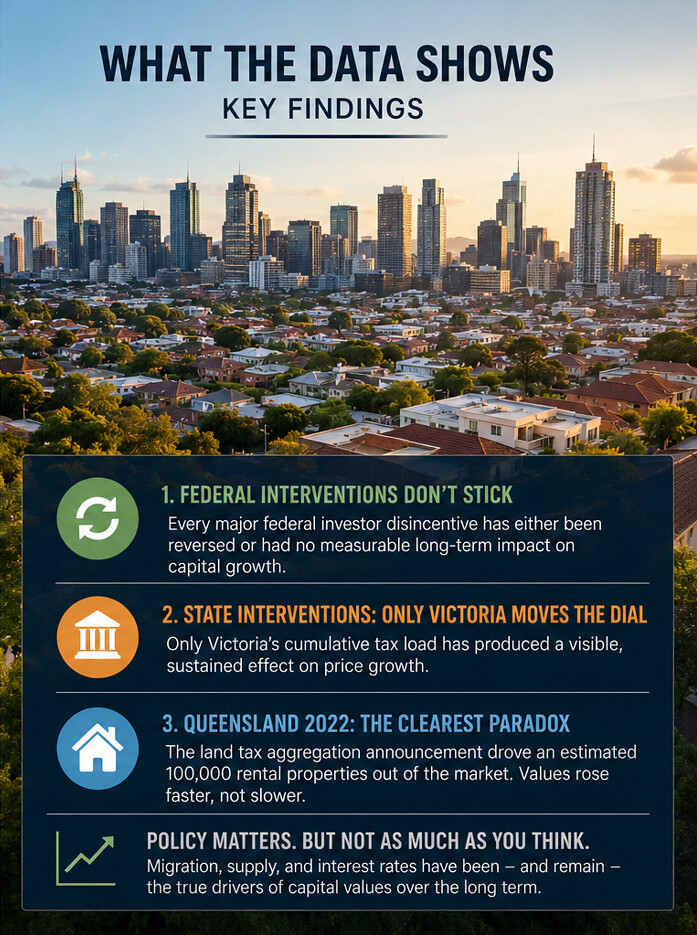
- Federal interventions almost always get reversed or absorbed. Every major federal experiment with removing investor incentives has either been reversed within years (1985 negative gearing; APRA 2014 investor cap; APRA 2017 interest-only cap) or has had no measurable long-term impact on capital growth.
- State interventions are stickier — but only Victoria has demonstrably moved the dial. Of the recent state-level interventions, only Victoria’s cumulative tax load (lower threshold, COVID levy, statewide VRLT, absentee surcharge) has produced a visible, sustained effect on price growth.
- Queensland 2022 is the cleanest paradox in the dataset. The interstate land tax aggregation announcement — even after being withdrawn — caused an estimated 100,000 rental properties to exit the market. Capital values rose faster, not slower, as a result.
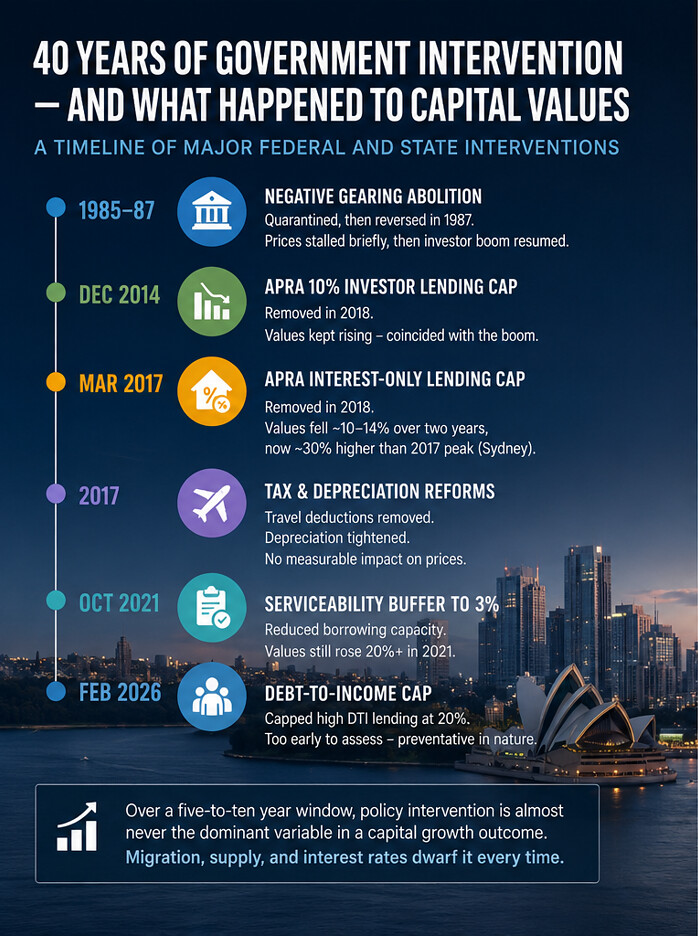
Over a five-to-ten year window, policy intervention is almost never the dominant variable in a capital growth outcome. Migration, supply, and interest rates dwarf it every single time.
This is not an argument that policy doesn’t matter. It is an argument that the property risks investors and developers most often worry about — the ones that fill the front page of the AFR — are not the risks that have historically determined whether their investment compounded.
Scope and methodology
This paper examines every material federal and state government intervention since 1985 that has been characterised — either at the time or in retrospect — as disincentivising residential property investment in Australia. Interventions are grouped into three categories:
- Tax interventions — changes to negative gearing, depreciation rules, land tax thresholds and rates, vacancy taxes, and foreign purchaser surcharges.
- Macroprudential interventions — APRA-led restrictions on investor lending growth, interest-only lending, serviceability buffers, and debt-to-income limits.
- Tenancy and regulatory interventions — changes to tenancy law that shift cost or risk from tenant to landlord.
For each intervention, two windows are examined:
- Year-of-change performance — what capital values did in the 12 months following announcement or commencement.
- Cumulative performance to today — compound growth from the date of intervention to current values (May 2026).
Where the intervention was state-specific, capital values for the relevant capital city are used. Where federal, combined-capitals data is used. Price data is drawn from CoreLogic (now Cotality) Home Value Index, ABS Residential Property Price Index, and Real Estate Institute of Australia data, cross-referenced where possible.
This paper deliberately does not adjudicate whether any individual intervention achieved its stated policy aim. The question is narrower: did the intervention disincentivise investors enough to matter at the level of capital growth?
Part one
Federal interventions
1985–87 — Negative gearing abolition
The intervention. In mid-1985, the Hawke/Keating government quarantined negative gearing on residential rental properties, prohibiting losses on rental investments from being offset against other income. The measure was reversed in September 1987 after sustained pressure from the property industry and rising rents in two markets.
Year-of-change. Sydney and Perth experienced sharp rental increases (31.9% and 33.5% respectively over the two-year period, on ABS CPI data). Capital growth in those cities stalled, but the cause was contested even at the time — both markets had unusually low vacancy rates before the policy change, and interest rate movements and the lead-up to the 1987 share market crash were significant confounding factors. Melbourne, Brisbane, Adelaide and Hobart did not experience the same rental dislocation.
1985 to today. Sydney median dwelling values have risen approximately 15-fold since 1985 (from circa $95,000 to circa $1.45 million in May 2026). The post-1987 reinstatement of negative gearing coincided with one of the largest investor booms in Australian history.
The 1985 episode is the most-cited precedent in Australian property policy debate — and it is the weakest evidence for the proposition that removing investor tax concessions causes long-term price damage. The reversal happened too quickly to test the counterfactual.
December 2014 — APRA 10% investor lending growth cap
The intervention. APRA instructed authorised deposit-taking institutions to limit annual growth in investor housing credit to no more than 10%. The cap was a response to investor lending growth running well above this benchmark, particularly in Sydney and Melbourne. The cap was removed in April 2018.
Year-of-change. Sydney dwelling values grew approximately 12% in 2015 and a further 15% in 2016 — some of the strongest growth on record. Melbourne grew approximately 11% and 13% over the same years. The cap coincided with, rather than ended, the 2013–2017 east-coast boom.
2014 to today. Sydney is roughly double its end-2014 median. Melbourne is approximately 60% higher. Brisbane is approximately 95% higher.
March 2017 — APRA interest-only lending cap
The intervention. APRA capped new interest-only lending at 30% of new mortgage flow and tightened serviceability standards. Because interest-only is overwhelmingly an investor product, this was the most directly investor-targeted federal intervention since 1985. Removed December 2018.
Year-of-change. This intervention bit. Sydney peaked in mid-2017 and fell approximately 14% to mid-2019. Melbourne fell approximately 11% over the same period. Combined-capitals values declined approximately 10%.
2017 to today. Sydney is now approximately 30% above its 2017 peak. Melbourne, alone among the capitals, is broadly at or just below its 2017 nominal peak — though the cause of that underperformance is now demonstrably state-level taxation rather than the 2017 federal measures, which were universal in their application.
2017 — Travel deductions and depreciation reforms
The intervention. The 2017 federal budget removed deductibility of travel expenses for residential rental property inspections and restricted depreciation of plant and equipment to new properties only (or properties acquired before 9 May 2017). A real cash impact on after-tax investor returns, particularly for older established stock.
Year-of-change and since. No measurable price effect attributable to these changes. The cash drag was material at the individual investor level but invisible at the market level, swamped by the broader macroprudential cycle.
October 2021 — Serviceability buffer raised to 3%
The intervention. APRA raised the mortgage serviceability assessment buffer from 2.5 to 3 percentage points above the loan rate, reducing borrowing capacity for all borrowers but with disproportionate impact on investors carrying multiple loans.
Year-of-change. Capital cities still posted 20%+ growth in 2021. The buffer change was overwhelmed by the COVID-era rate environment.
2021 to today. National dwelling values are approximately 30% higher than late 2021 despite the buffer remaining in place throughout.
February 2026 — APRA debt-to-income cap
The intervention. APRA capped the share of new mortgages with debt-to-income ratios at or above six times income at 20% of new lending, applied separately to investor and owner-occupier portfolios. Investors are over-represented in this segment, with approximately 10% of investor loans currently above the threshold versus approximately 4% of owner-occupier loans.
Year-of-change and since. Too early to assess. The cap commenced 1 February 2026 and the immediate impact has been modest because most lending currently sits below the threshold. The intervention is preventative rather than reactive.
Part two
State interventions
Queensland — the 2022 land tax episode
The intervention. Announced in the 2021–22 Queensland Budget Update and passed in June 2022, the proposed reform would have calculated state land tax for Queensland investors using the total value of an owner’s Australian land — including land held in other states. After sustained backlash from interstate investors and other state governments refusing to share data, the Queensland government withdrew the reform in September 2022.
Year-of-change. Brisbane was already in strong growth when the reform was announced. At least ten Brisbane suburbs experienced growth of 20% or higher in the six months to August 2022. Critically, the announcement is estimated to have caused approximately 100,000 rental properties to exit the Queensland market, contributing to a 20% rent escalation through 2022 and tightening the rental market further.
2022 to today. Brisbane dwelling values have risen approximately 86% over five years, and are approximately 37% higher than May 2022. Brisbane median house values crossed $1 million for the first time in May 2025 and are now around $1.05 million. The land tax announcement, on the data, did not slow capital growth — the supply withdrawal it caused arguably accelerated it.
The Queensland 2022 episode is the clearest natural experiment in the dataset. An anti-investor intervention withdrew supply from the rental pool, which compressed yields, tightened the market, and contributed to capital growth rather than suppressing it.
Victoria — the cumulative tax load, 2018–2026
Victoria is the only Australian jurisdiction where the cumulative effect of state-level intervention is genuinely visible in the capital growth data. The interventions did not arrive as a single shock but as a sequence:
- 2018: Vacant Residential Land Tax (VRLT) introduced for 16 inner and middle Melbourne LGAs.
- January 2024: Land tax tax-free threshold reduced from $300,000 to $50,000; marginal rates increased; an additional COVID Debt Levy applied to investment property for 10 years.
- January 2025: VRLT extended statewide to all of Victoria.
- January 2026: VRLT extended to undeveloped residential land in metropolitan Melbourne held vacant for five or more years; congestion levy raised 73% and zone expanded; vendors prohibited from passing land tax to buyers in contracts under $10.7 million.
- Throughout: Absentee owner surcharge progressively raised to 4%.
Cumulative effect. Between March 2023 and March 2025, residential bond numbers across Victoria declined by approximately 22,000 — evidence of investor exit at scale. Melbourne dwelling values grew approximately 20% from March 2020 to mid-2025, compared with 42% in Sydney and over 90% in both Brisbane and Perth over the same period. Five-year cumulative growth in Melbourne sits at approximately 8.5%, against figures more than ten times higher in the mid-sized capitals.
Today. Melbourne is the clear long-term laggard among the capitals, with values approximately 1.3% below their March 2022 peak as at April 2026. Capital is visibly rotating out of Victoria into Brisbane, Perth, and Adelaide. While weaker population growth and a more challenging state economy have contributed to this outcome, the timing and scale of the divergence aligns closely with the 2023–24 announcement and implementation of new investment property taxes.
Victoria is the exception that proves the rule. It is the only jurisdiction where the cumulative load of state intervention is now meaningful enough to be reshaping where investor capital flows.
Other state interventions
New South Wales. Foreign investor surcharge duty (currently 9%) and surcharge land tax (5%); progressive land tax rate increases. No measurable disincentive effect on broader investor activity — Sydney remains the largest investor market in Australia by dollar value.
Tenancy reform across all states. Caps on rent increase frequency, removal of no-grounds terminations, minimum housing standards, and pet provisions. These have rebalanced rights and added landlord cost and risk. No state has experienced measurable capital growth suppression attributable to tenancy reform alone.
Federal foreign buyer ban (2025). Two-year prohibition on foreign persons purchasing established dwellings. Too early to assess. Foreign investment in established dwellings was already a small share of the market, so the impact at market level is expected to be limited.
Part three
Summary at a glance
The full dataset distilled into a single view. “Year-of-change” measures capital growth in the 12 months following announcement or commencement. “Cumulative to today” measures growth from the intervention date to May 2026.
| Intervention | Year-of-change | Cumulative to today | Verdict |
| Negative gearing abolition (1985–87) | Mixed; rents up in Syd/Per | Sydney median ~15x | Reversed before counterfactual could be tested |
| APRA investor cap (Dec 2014) | Sydney +12%, Mel +11% | Sydney ~+100% | No measurable disincentive effect |
| APRA interest-only cap (Mar 2017) | Sydney −14% to mid-2019 | Sydney ~+30% above 2017 peak | Real bite; reversed within 18 months |
| Travel + depreciation reforms (2017) | Nil at market level | Nil at market level | Cash drag at individual level only |
| Serviceability buffer to 3% (Oct 2021) | Capitals +20% in 2021 | National ~+30% | Overwhelmed by COVID rate environment |
| QLD interstate land tax aggregation (2022) | Brisbane +25%+ in 12 months | Brisbane ~+37% since May 2022 | Withdrawn; supply exit accelerated growth |
| Victoria cumulative tax load (2018–26) | Bond numbers −22k (2023–25) | Melbourne ~+8.5% over 5 years | Only state where intervention has moved the dial |
| APRA DTI cap (Feb 2026) | Too early | Too early | Preventative; modest immediate impact |
What this means for investors and developers
Three practical implications follow from the data.
One. Discount the noise around proposed federal reform.
Forty years of evidence shows that federal interventions targeting investors are either reversed before they bite, calibrated narrowly enough to be absorbed, or overwhelmed by the broader macro cycle. The 2017 APRA interest-only cap is the only federal intervention in the dataset that produced a sustained, measurable price decline — and even that was reversed within 18 months and recovered within three years.
This does not mean federal reform should be ignored. It does mean that decisions to buy, hold, or sell investment property should not be driven by speculation about federal policy that has not yet passed, and often will not pass.
Two. Take state-level intervention seriously — but only in aggregate.
Single state interventions almost never matter at the capital growth level. Cumulative state interventions can. Victoria is the case study: no individual measure was decisive, but the combined load of VRLT, threshold reduction, COVID levy, and absentee surcharge has produced a visible, sustained divergence from other capitals.
For investors, this argues for jurisdictional diversification — not as a defensive measure against any single tax, but as protection against the slower-moving risk of cumulative state policy drift.
Three. Anti-investor intervention can paradoxically support capital values.
The Queensland 2022 episode is the most counter-intuitive finding in the dataset. A reform designed to discourage investor activity caused investor exit, which withdrew supply from the rental pool, which tightened rents, which compressed yields, which supported capital values. The same dynamic is observable in Victoria today, where investor exit is contributing to a tightening rental market even as capital growth lags.
This is not an argument for bad policy. It is an argument that the relationship between policy intervention and capital growth is rarely linear and almost never operates the way headline coverage suggests.
|
THE CORE TAKEAWAY Migration, supply, and interest rates dwarf policy intervention as drivers of capital growth in Australian residential property. Of the eight major interventions examined in this paper, exactly one — Victoria’s cumulative state tax load — has produced a sustained, measurable underperformance attributable to government policy. Every other intervention has been either reversed, absorbed, or paradoxically supportive of values. |
About Fox Property Advisory
Fox Property Advisory Pty Ltd is a Queensland-based independent valuation and advisory firm covering residential, commercial, rural, and specialised asset classes. The firm is API and QVRB registered and provides independent advice to private investors, developers, lenders, and institutional clients across South East Queensland and beyond.
Sebastian Fox is the Principal of Fox Property Advisory and a registered valuer with experience across institutional valuation, development feasibility, and acquisition advisory. Fox Property Advisory’s service offering includes Settlement Valuation Support, Project Valuation Management, and Builder Valuation Advisory, supporting developers and builders through the full project lifecycle.
Disclaimer
This paper is provided for general information and discussion only. It is not intended as, and should not be relied upon as, financial, taxation, legal, or investment advice. Capital growth figures are sourced from publicly available data including CoreLogic (Cotality), the Australian Bureau of Statistics, and the Real Estate Institute of Australia, and are presented as approximations rounded for clarity. Past performance is not indicative of future returns. Readers should obtain independent professional advice before making any investment decision.